


Georgia Employees Are Turning Down Higher Pay to Work for Generous Companies
Friday, October 9th, 2026
Employees are not just saying generosity matters to them. They are making financial decisions because of it.
goBeyondProfit and Georgia CEO recently released the 2026 Business Generosity Report, a study of how generosity shapes the modern workplace. This week's findings detail the career and financial decisions employees are making in pursuit of a generous workplace.
The data shows a workforce actively using generosity, or its absence, as a deciding factor in where they work, what job offers they accept, and how long they stay.
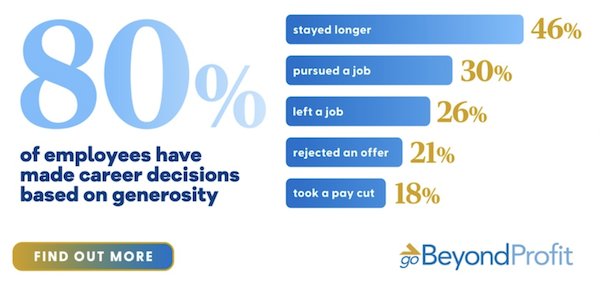
Employees Are Making a Financial Sacrifice in Search of Generosity
Employed adults were asked whether a company's generosity had ever shaped an employment decision. Three findings stand out:
- 46% have stayed at a company longer, believing they could earn more elsewhere.
- 18% have taken an actual pay cut to work for a generous company.
8 in 10 Georgia employees have left a job over a lack of generosity (26%), or actively pursued a job because a company was generous (30%), or turned down an offer from a company they viewed as ungenerous (21%) — in addition to those who stayed for less or took a pay cut.
The share of employees who say generosity has never influenced a career decision fell from 34% in 2025 to just 20% in 2026. That's a 14-point shift in a single year.
The 18% Who Took an Actual Pay Cut
Unlike employees who stayed at a company believing they could earn more elsewhere, the 18% of employees who took an actual pay cut gave up known income to work somewhere they considered generous.
78% of employees who took a pay cut rate their employer as “Best in Class” or “Above Average” on generosity — substantially higher than any other group in the survey. These are employees who found a genuinely generous company and know it.
Nearly Half of Employees Stay for Less Pay
This is the single most-selected response to the question. Not only did these employees knowingly make a financial sacrifice to stay with a generous employer, but these loyal respondents outperform their fellow employees across every measure of engagement this survey tracks: greater loyalty (+15.6 points), increased collaboration (+13.3 points), more effort and new ideas (+12.0 points), better customer engagement (+11.3 points), and higher productivity (+10.4 points).
This Pattern Holds Across Every Generation
The 2026 report breaks these findings down by generation. The career-decision data is not concentrated in younger employees, it spans the entire workforce.
- Gen Z (18–29) is the most likely generation to have actively pursued a job because a company was generous (37.9% — a 28-point gap over Baby Boomers, who are at 9.3%).
- Millennials (30–45) are the most likely to have stayed at a generous company for less pay (52.7%).
- Even among Baby Boomers, the generation most skeptical of their own employer's generosity, 60.5% say generosity has shaped at least one career decision.
The generosity driving these decisions is not a bigger benefits package. Employees are responding to how a company treats people and whether there is a consistency in that humanity that can be felt across the business.
Generosity is no longer a sentimental preference held by a passionate few. Generosity drives both daily work effort and long-term career choices. When employees see generosity in action in a business, they are willing to make less, work harder, and stay longer.
The 2026 Business Generosity Report gives employers a category-by-category benchmark for where their generosity investments are earning real credit with employees — and where the gap between executive intent and employee experience is costing them the most.

